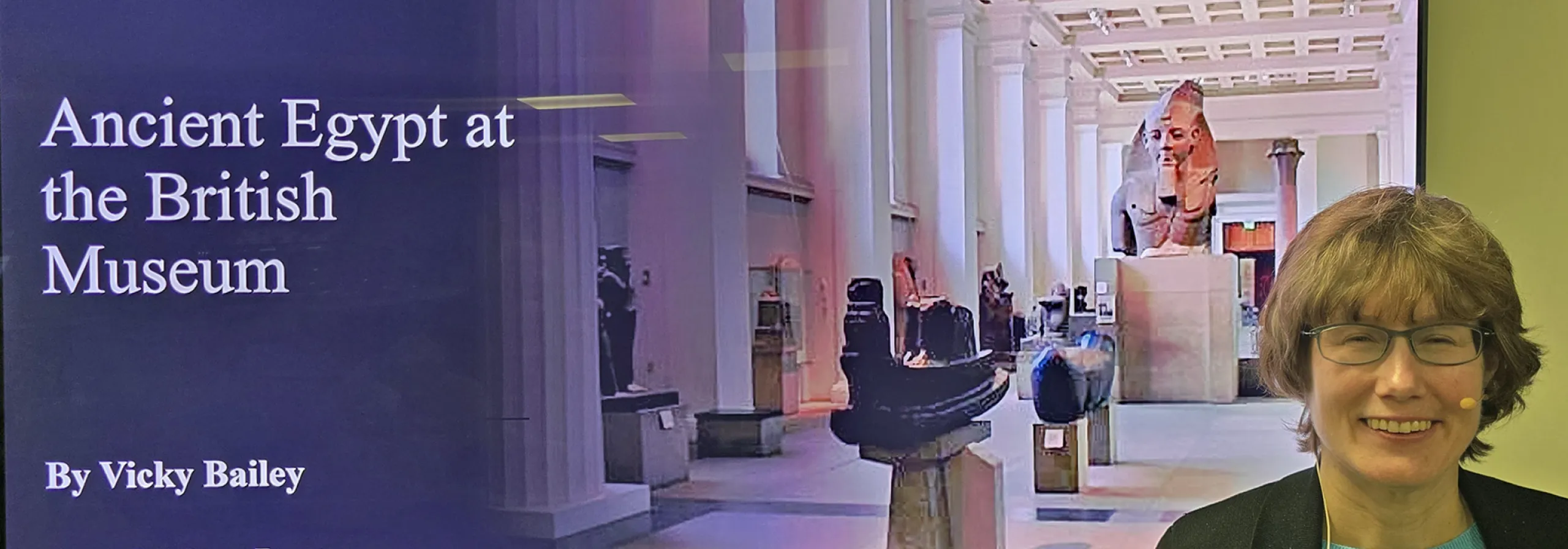
How does one summarise four thousand years of history in an hour? Vicky Bailey used artefacts from the British Museum to cover the ground, from the first Pharaoh, Narmer, who first unified Egypt, to the last, Cleopatra, whose reign ended with Roman conquest.
Vicky started by describing how the Rosetta Stone was used to decipher both hieroglyphics and demotic scripts from the ancient Greek also carved on the tablet. Hieroglyphs were the official script of ancient Egypt, while demotic script was the everyday business script. Neither exactly followed modern rules of grammar and representation. The Rosetta Stone was rediscovered by French archaeologists in the eighteenth century, and then passed to the British after Nelson's victory at the Battle of the Nile. No-one could decipher it, until a Frenchman, Jean-François Champollion, was able to do so in 1822, using his knowledge of Coptic as a bridge between the ancient scripts and modern ones. We were then able to discover much history of Egypt and its religious system.
The ancient history is divided into three periods. The capital for the first two periods was Memphis, near Cairo, and Pharaohs were buried in pyramids both near Memphis and then near Cairo. Pharaohs were buried with extensive grave goods to ease their afterlives, which attracted grave robbers. In the more recent period, Pharaohs were buried in the Valley of the Kings, west of Thebes, now Luxor, which was the site of the most powerful Egyptian deity, Amun-Ra. Many of these burial sites were also robbed, though Tutankhamun's tomb survived intact.
Our lecturer illustrated her talk with pictures of Pharaohs, grave goods, religious icons and also pictures of many of the sites in Egypt to give context. Many TASH members have visited Egypt, but everyone left the lecture wanting to go back and revisit the sites.
About our Speaker
Vicky Bailey became a London Blue Badge Tourist Guide in 2005, receiving an award as the 'Best Guide in Gallery Exams', one of her main areas of interest being Ancient Egypt. She has studied hieroglyphs and carries out volunteer work in the Egyptian department at the British Museum. Vicky leads specialist tours at relevant sites across London and also delivers lectures on this subject.
Highlights of her guiding career have included giving a talk on BBC Radio 4 about the execution site of Tyburn and writing a book on the British monarchy.
TASH Talk Report by Robert Gurney - November 19th 2026: Ancient Egypt at the British Museum by Vicky Bailey
Published on: November 20, 2026
Published By Society: Henley-on-Thames


