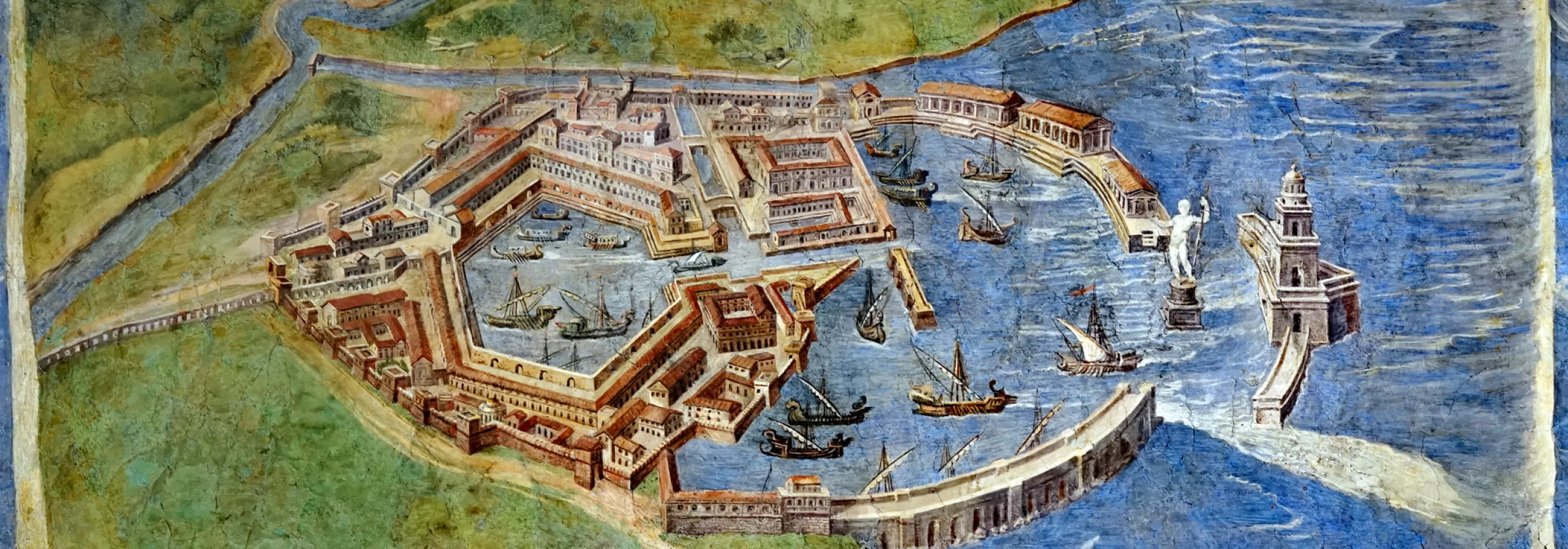
In the days of the Roman republic, Rome was land-based power, and only developed a navy to counter the threat from Carthage.
The original port was in Rome itself. However, as Rome grew, there was a need to import more supplies, particularly grain, olive oil, wine and fish paste. Ostia was then built as the port of Rome.
Ships became larger, and could no longer navigate up the Tiber to Rome. The small village of Ostia was developed as a port, starting in the reign of Claudius. A larger port of Portus was developed in the later Roman empire as Ostia started to silt up. The infrastructure of Ostia supported both ports, with extensive warehouses, mills and so on. Ostia developed into a town of about 100000 people, with temples, law courts and all the infrastructure of a merchant centre.
The original town was abandoned after the sack of Rome by the Vandals, as the ports silted up and as the demand from the Roman population reduced. Much of the area still exists, although over the century it has been robbed, including in the building of the Vatican. The area has now partly been excavated, including by our lecturer. He showed examples of finds as well as the foundations themselves.
The lecture to The Arts Society Henley (TASH) in May 2026, was illustrated by plentiful maps, showing how the area changed over the centuries. Our lecturer, Dr Sam Moorhead, is the retired National Finds Adviser for Iron Age and Roman coins in the Portable Antiquities and Treasure Section at the British Museum. His expertise shone through, and kept his audience rapt in concentration with another outstanding lecture.
TASH Talk report by Robert Gurney: May 2026 - The Port of Ostia – Rome's best kept Secret? by Sam Moorhead
Published on: May 26, 2026
Published By Society: Henley-on-Thames
