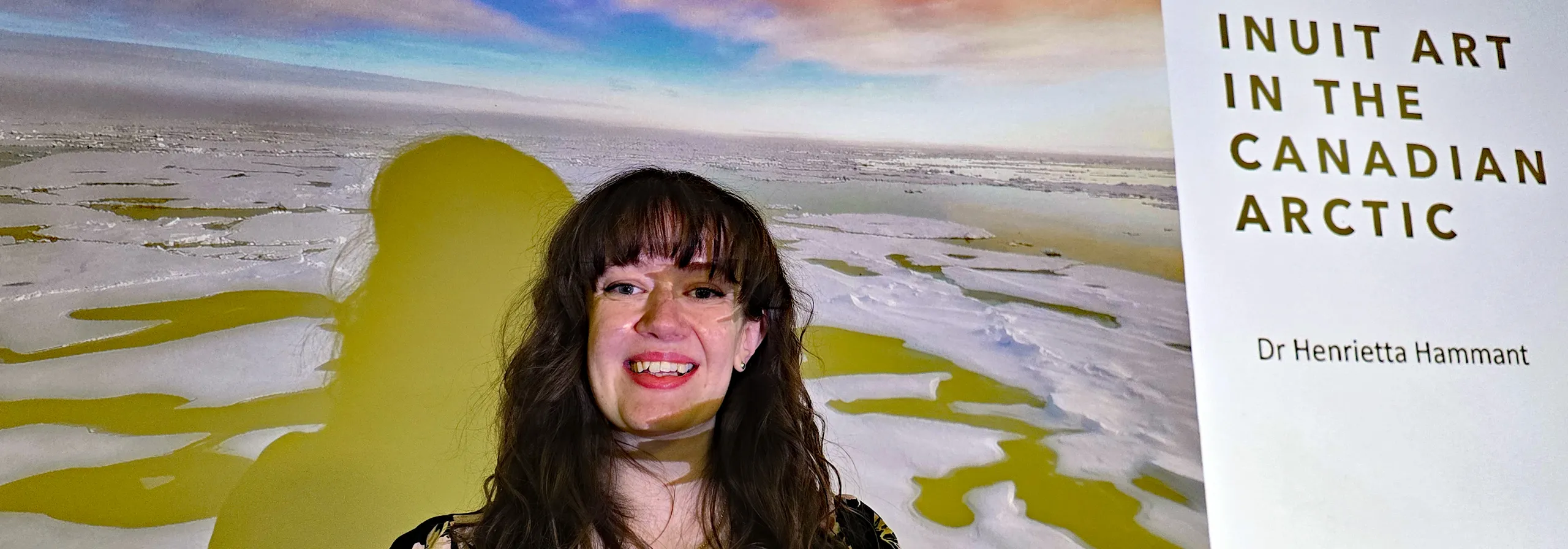
The November 2026 lectures were presented (in our clubhouse and over YouTube) to The Arts Society Henley (TASH) by Dr Henrietta Hammant. Her fascinating topic, “A History of Inuit Art in the Canadian Arctic”, was very highly rated by our 450+ members.
Dr Hammant is a museum anthropologist with a love of the polar regions. She has worked in a
variety of museums in the UK and Canada, including the Itsanitaq Museum in Churchill, Manitoba (‘The Polar Bear Capital of the World’) and the Polar Museum in Cambridge.
From religion to the environment, and colonial encounters to the power of the western art market, Henrietta's talk explored the many interactions – expected and unexpected – that have shaped the history of Inuit Art in Canada.
The Inuit (“the people” in the local language) moved into Northern Canada at the end of the last Ice Age, from Eastern Siberia to Alaska and then across Canada to Greenland. They were based mainly west and south-west of Hudson’s Bay and were traditionally nomadic hunters.
Their traditional art was small, mainly carved ivory and similar, representing animals, birds and fish, and also small toys to improve hand-eye co-ordination for hunters. Europeans moved into their territory in the 16th Century, seeking whales and other resources, and trade started as the Inuit territory was traditionally short of metal and similar resources. One Inuit skill in demand was for art, so the Inuit learnt to produce carvings that appealed to their European and later Canadian traders.
The Canadian government thought in the 20th Century that the Inuit culture would die out, as primitive, and forced both settlement in towns and forced boarding schools for children, breaking up families and taking away the hunting and nomadic basis of the society. In the 1950s onwards, people realised that there was a demand for Inuit art and carvings and encouraged the development of this market. Much of what is produced is recent and reflects Canadian and wider European tastes.
Henrietta showed many exquisite carvings and prints. The style reflected older pieces, but also the demands of the market. For instance, much recent carving is in soapstone, which is easy to carve but very soft, so the style of carving has been altered at the request of the Canadian Postal Service as rounded pieces are easier to ship without damage.
Henrietta spoke very well; lyrical and amusing, she is a new Arts Society lecturer, and indeed this was her first Arts Society talk. Everyone who listened was roused to find out more about this area, which was not well known to most TASH members.
TASH Talk Report by Robert Gurney: A History of Inuit Art in the Canadian Arctic by Dr Henrietta Hammant, November 2025
Published on: February 27, 2026
Published By Society: Henley-on-Thames
